Birth Doula vs Postpartum Doula: What’s The Difference?
Choosing between becoming a birth doula and a postpartum doula is one of the first big decisions in your doula career. The two roles support families at different moments, and they shape your schedule, your daily work and your business in very different ways. This guide compares birth doula vs postpartum doula side by side so you can see which path fits your personality and lifestyle.
Neither path is better than the other. Both offer meaningful work with families and a real opportunity to build a sustainable doula business. The right choice is the one that matches how you want to work.
What is the difference between a birth doula and a postpartum doula?
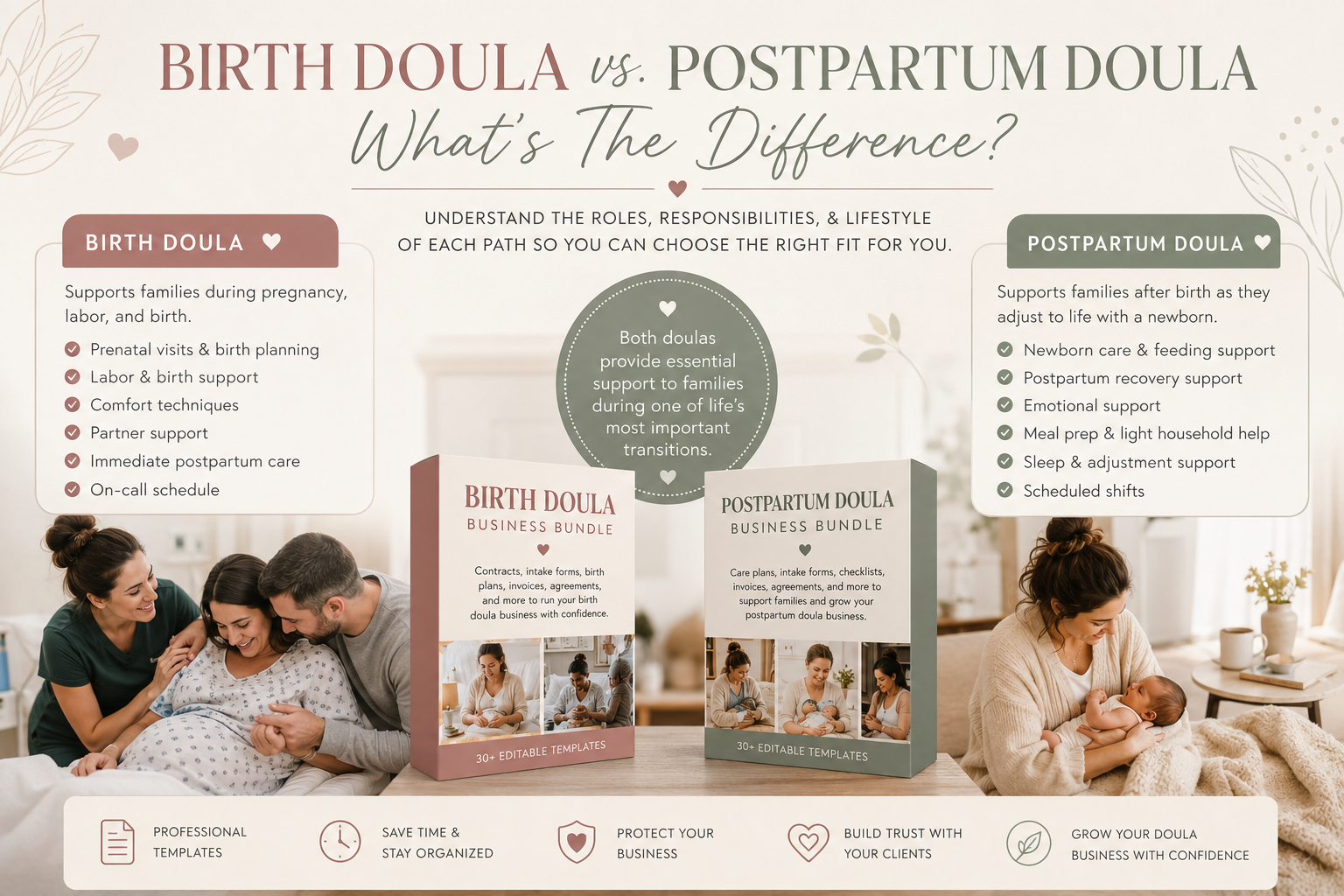
A birth doula supports families during pregnancy, labor and birth, while a postpartum doula supports families after the baby arrives. The biggest practical difference is the schedule: birth doulas are on call around due dates, while postpartum doulas usually work scheduled shifts.
Both are non-medical roles. As Cleveland Clinic explains about doulas, “Doulas aren’t medical professionals and can’t provide treatment or medical advice.” Here’s how the two roles compare at a glance:
| Comparison | Birth doula | Postpartum doula |
|---|---|---|
| When you support families | During pregnancy, labor and birth | After birth, in the weeks or months that follow |
| Main focus | Labor comfort, birth preparation, emotional support and advocacy | Recovery support, newborn care help, feeding support, household help and family adjustment |
| Schedule | On call around due dates, including nights and weekends | Scheduled daytime, evening or overnight shifts |
| Where you work | Hospitals, birth centers and clients’ homes | Mainly clients’ homes |
| Length of client relationship | Several prenatal visits, the birth and a postpartum check-in | Can continue for weeks or months |
| How pricing is often structured | A package per birth | Hourly rates or packages of support hours |
What does a birth doula do?
A birth doula provides emotional, physical and informational support to families before and during birth, helping them feel prepared, confident and supported. The work typically centers on prenatal visits, birth preparation and continuous support during labor.
A birth doula’s responsibilities often include:
- Prenatal visits
- Birth planning sessions and creating birth preferences
- Continuous labor support
- Comfort measures during labor
- Emotional support for partners
- Evidence-based education about birth options
- Immediate postpartum support after the birth
Birth doulas are on call, which means being ready to go whenever labor starts, whether that’s at 2 PM or 2 AM. Being present for a birth can be one of the most rewarding parts of the work.
What does a postpartum doula do?
A postpartum doula supports families after birth, helping parents recover, adjust and feel confident caring for their newborn. Visits are usually scheduled in advance, either during the day or overnight.
A postpartum doula’s responsibilities often include:
- Newborn care support and education
- Feeding support, including breastfeeding and bottle feeding guidance
- Postpartum recovery education
- Emotional support for parents
- Meal preparation and light household help
- Newborn sleep guidance
- Referrals to other professionals and community resources
- Support as the whole family adjusts
Postpartum doulas offer feeding and newborn support within the scope of their training, and they refer families to professionals such as lactation consultants or healthcare providers when more specialized help is needed.
What are the biggest differences between birth and postpartum doula work?
The biggest differences are when you support families, how predictable your schedule is, where you work, the type of support you give and how long you work with each family. Here’s how each one plays out day to day.
1. Timing of support
Birth doulas work before and during birth. Postpartum doulas work after birth, sometimes starting the day a family comes home.
2. Schedule and availability
Birth doulas keep their phones nearby and stay available throughout each client’s due date window, which can mean overnight births and last-minute schedule changes. Postpartum doulas typically work booked shifts, whether morning, evening, overnight or weekends. If predictable hours matter to you, postpartum work may suit you better.
3. Work environment
Birth doulas support families in hospitals, birth centers and at home births. Postpartum doulas work mainly in clients’ homes, including overnight newborn care.
4. Type of support
Birth doulas focus on labor comfort techniques, birth education, advocacy, partner support and emotional reassurance during labor. Postpartum doulas focus on recovery support, feeding support, newborn care education, household help and emotional wellbeing.
5. Client relationships
Birth doulas build relationships over several prenatal appointments and the birth itself. Postpartum doulas may work with the same family for weeks or even months.
Which type of doula has more flexible hours?
Postpartum doulas usually have more predictable schedules, because their visits are booked in advance. Birth doulas need to stay available around due dates and can be called at any hour.
Labor can last four hours or twenty-four, so a birth doula can’t always plan the days around a due date. Postpartum work still has busy stretches, but you’ll generally know your shifts ahead of time. If work-life balance and a predictable calendar are priorities, that’s an important difference to weigh.
Which type of doula earns more?
Neither type of doula consistently earns more. Income depends on your location, experience, training, the services you offer and local demand, and on how many clients you can support at once.
The two roles are usually priced differently, which affects how income adds up:
- Birth doulas commonly charge a package price per birth, so income depends on how many births you can take each month while staying reliably on call.
- Postpartum doulas often charge hourly or sell packages of support hours, so income depends on how many hours you book.
Some doulas offer both services to create more than one income stream. For help setting your rates and building packages, read how to price your doula services.
Should you become a birth doula?
Birth work may be a great fit if you love the energy of labor and birth and you’re comfortable being on call. It suits people who stay calm in intense moments and feel strongly about supporting families’ birth choices.
Birth work may suit you if you:
- Love the energy of labor and birth
- Enjoy fast-paced, unpredictable environments
- Feel passionate about birth advocacy
- Don’t mind being on call
- Enjoy supporting families through intense moments
If this sounds like you, the step-by-step guide on how to become a birth doula covers training, certification options and setting up your business.
Should you become a postpartum doula?
Postpartum work may be a great fit if you love caring for newborns and families and prefer a more consistent schedule. It suits people who enjoy building long-term relationships and helping families find their rhythm.
Postpartum work may suit you if you:
- Prefer consistent, scheduled hours
- Love newborn care and family support
- Enjoy long-term client relationships
- Want a more predictable work week
- Feel passionate about family recovery and adjustment
To explore this path, read how to become a postpartum doula, and see how to be a professional postpartum doula from day one for setting up a client experience families trust.
Can you be both a birth and postpartum doula?
Yes. With training in both areas, you can offer birth and postpartum support and care for families from pregnancy through the early weeks with a new baby. Some go further and offer full-spectrum support across many reproductive experiences, as covered in how to become a full spectrum doula.
Offering both services can help you:
- Support families through their whole journey, not just one stage
- Build deeper, longer relationships with clients
- Offer postpartum support to the birth clients who already know and trust you
- Create more than one income stream
The catch is that running two kinds of services means two sets of paperwork: different contracts, different intake questions and different welcome materials. The Full Spectrum Doula Business Bundle is built for exactly that situation. It brings birth and postpartum contracts, intake forms, welcome materials, questionnaires, postpartum plan templates and invoice templates together in one Canva-editable set, so both sides of your business look consistent and professional.
What paperwork does each type of doula need?
Both birth and postpartum doulas need a contract, an intake form and a clear way to invoice. Beyond that, the paperwork follows the work: birth doulas focus on birth preferences, while postpartum doulas need forms for care plans and household support.
Families want to work with a doula who feels organized and prepared, and your paperwork is often one of the first things they see.
Common birth doula documents:
- Service contract
- Client intake form
- Birth preferences form
- Welcome packet
- Invoices and payment receipts
Common postpartum doula documents:
- Service contract
- Postpartum care plan
- Newborn care questionnaire
- Household support checklist
- Feeding log
- Client welcome guide
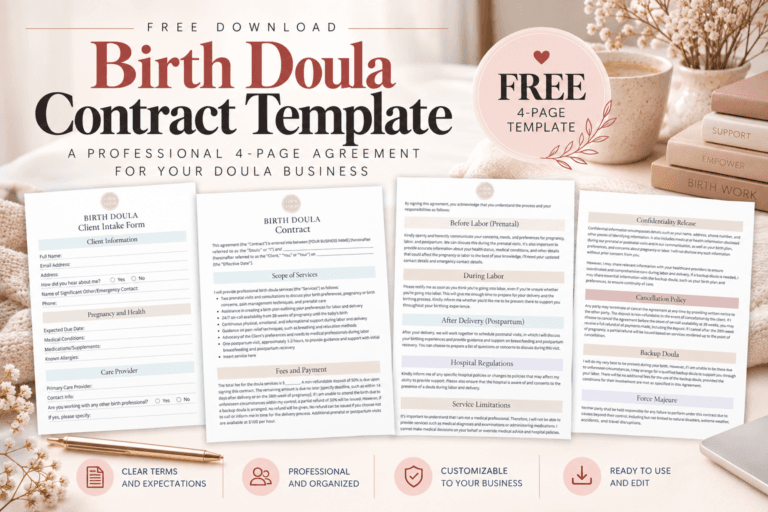
Start with your contract. What to include in a doula contract template explains every clause, and you can download a free birth doula contract template or postpartum doula contract template to get started.
Creating every other document from scratch while you’re also trying to find clients is where a new doula business can easily stall. For birth doulas, the Birth Doula Business Bundle covers the full onboarding set (a 4-page contract, intake form, welcome booklet, birth preferences, photo release and invoices), ready to customize in Canva. For postpartum doulas, the Postpartum Doula Business Bundle does the same with a postpartum contract, intake form, welcome booklet and invoices. Either way, you can spend your time supporting families instead of formatting documents.
Which type of doula is right for you?
The right choice depends on your personality, your preferred schedule, your strengths and the type of support you enjoy giving most. There’s no universally better option, and you don’t have to choose only one forever.
Ask yourself:
- Do I feel energized or drained by unpredictable, on-call work?
- Am I drawn more to the birth room or to the quieter weeks at home with a newborn?
- Do I want short, intense client relationships or longer, steady ones?
- What schedule fits my family and my life right now?
- Which kind of support do I find myself reading and learning about most?
If you love labor support, advocacy and being present for births, birth work may be your path. If you love newborn care, family education, predictable schedules and long-term relationships, postpartum work may fit you better.
What other questions do people ask about birth and postpartum doulas?
Here are quick answers to common questions about the two roles.
Is a birth doula the same as a postpartum doula?
No. A birth doula supports families during pregnancy, labor and birth, while a postpartum doula supports them after the baby arrives. Some doulas offer both.
Can a doula offer both birth and postpartum services?
Yes. With training in both areas, a doula can support families from pregnancy through the postpartum period. Clear, separate packages and paperwork for each service make this easier to manage.
Which type of doula has more flexible hours?
Postpartum doulas generally have more predictable schedules, because their visits are booked in advance. Birth doulas need to be on call around their clients’ due dates.
Which type of doula earns more money?
Neither consistently earns more. Income depends on location, experience, services and how many clients or hours you take on. Birth doulas often charge per birth, while postpartum doulas often charge by the hour.
Do I need contracts and intake forms as a doula?
Yes. A contract sets clear expectations about your services, fees and policies, and an intake form gathers the information you need before you start. Have your contract reviewed by a qualified local attorney before you use it.
Where should you go from here?
Once you’ve chosen your path, the next step is turning it into a business: training, services, pricing, paperwork and your first clients. How to start a doula business walks through each step in order.
Whether you’re drawn to the birth room or the postpartum period, professional systems, clear communication and a strong client experience will help you build a business families trust.