How To Become A Birth Doula in 2027: Complete Beginner’s Guide
Thinking about how to become a birth doula in 2027? You probably have plenty of questions. Do you need certification? How much does training cost? What does a birth doula actually do in the birth room, and how do you find your first clients once you’re trained?
This guide answers each of those questions in order. It covers the role, training and certification, the hands-on experience you’ll need, and the business side that many new doulas don’t think about until later: services, pricing, paperwork, a website and your first clients.
What is a birth doula?
A birth doula is a trained, non-medical support person who gives families continuous emotional, physical and informational support before, during and shortly after birth. Doulas don’t replace doctors, midwives or nurses. They work alongside the care team and focus on comfort, reassurance and preparation.
As Cleveland Clinic explains about doulas, “Doulas aren’t medical professionals and can’t provide treatment or medical advice.” Within that scope, a birth doula’s support can include:
- Helping families prepare for labor and birth
- Explaining what to expect, in non-clinical terms
- Comfort techniques, positions and breathing support
- Encouraging and guiding the birthing person’s partner
- Helping families feel heard and prepared to ask their care team questions
- Immediate support in the hours after birth
If you’re still deciding which path fits you, birth doula vs postpartum doula: what’s the difference? compares the two roles side by side, including schedules and how each is usually priced.
Is becoming a birth doula worth it?
For many people, birth work is deeply meaningful, and it can grow into a business you run on your own terms. It also asks a lot of you, so it’s worth weighing both sides honestly before you invest in training.
Birth doulas may work independently, through an agency, with a nonprofit or community program, or alongside healthcare organizations. Things to consider before you commit:
- On-call life. Labor doesn’t follow a schedule, so you need to be reachable around each client’s due date, including nights and weekends.
- Emotional intensity. Births can be long, unpredictable and sometimes difficult, and you’ll need ways to recover afterward.
- Running a business. Most independent doulas also handle pricing, paperwork, marketing and taxes.
- Variable income. What you earn depends on your local market, your experience and how many births you can take on while staying reliably available.
Do you need a degree to become a birth doula?
No. A medical background or college degree usually isn’t required to train as a birth doula. DONA International, one of the best-known doula organizations, says on its become a doula page that “No prior medical background or degree is required.”
Requirements can still vary. Individual trainers, agencies, hospitals and programs may set their own prerequisites, so check the specific program or employer you’re considering. If you hope to work with Medicaid clients, note that states set their own rules for doula services. Georgetown University’s Center for Children & Families tracks state Medicaid coverage for doula care, so check your state’s program before you choose a training path.
Step 1: Learn what a birth doula actually does
Before you pay for training, get a clear picture of the day-to-day work. A birth doula’s support usually happens in three stages: during pregnancy, during labor and right after birth.
During pregnancy
Prenatal meetings are where trust is built. You might talk through the family’s hopes and fears, help them prepare for labor, discuss their birth preferences, share educational resources and help them write down questions for their healthcare team.
During labor
During labor, you offer continuous presence and reassurance. That can include comfort measures, position suggestions, breathing support, encouragement, support for the partner and non-clinical information that helps the family understand what’s happening.
Immediately after birth
Many birth doulas stay for a short time after the baby arrives and offer a postpartum follow-up visit. Exactly what’s included depends on your package and your scope of practice.
Step 2: Choose a birth doula training program
Choose a program whose curriculum, practical requirements and values fit the kind of doula you want to be, not just the one with the lowest price. Training is the foundation for your skills, your confidence and any certification you pursue later.
DONA International’s birth doula certification is one widely known example. Its published requirements include a “DONA approved birth doula workshop (16–24 hours),” a “Childbirth education course (8 hours),” a “Lactation support education course (3 hours),” required reading, attending births, and evaluations. Other organizations structure their training differently, so compare a few before you decide.
When comparing programs, look at:
- Curriculum and how much hands-on practice it includes
- Mentorship and support after the workshop
- Total cost, including certification fees, books and any membership
- Format: in person, online or hybrid
- Continuing education options
- How clearly it teaches ethics and scope of practice
- The community of doulas you’ll be connected to
Step 3: Understand birth doula certification
Training, certification and legal requirements are three different things. Training is where you learn the skills. Certification means you’ve met a specific organization’s requirements and can say you’re certified by that organization.
Certification usually takes more than a workshop. DONA’s birth doula certification, for example, requires the “Certification packet submitted within 3 years of workshop completion,” and states that “DONA International membership required for packet submission.” Separately, check whether your state, an employer or a Medicaid program has its own requirements for doulas. Only describe yourself as “certified” once you’ve actually completed an organization’s certification.
Step 4: Develop essential birth doula skills
The most important birth doula skills are about people, not procedures. Families remember how calm, present and prepared you were.
Six skills to build from day one:
- Communication. Explaining things clearly and kindly, to the birthing person and to their partner.
- Active listening. Hearing what families need, not just what they say.
- Emotional support. Staying steady and reassuring when labor gets intense.
- Comfort techniques. Positions, touch, breathing and environment.
- Professional boundaries. Knowing your scope and when to refer families to their healthcare provider or another professional.
- Organization. Keeping track of clients, due dates, documents and communication.
Step 5: Gain practical experience
Hands-on experience is where your training turns into confidence. Many certification pathways require you to attend births and collect feedback before you can certify.
DONA’s requirements, for example, include continuous in-person labor support for three births with different clients, with a minimum of 15 total hours of labor support. To build experience and connections:
- Stay in touch with the doulas you trained with
- Ask experienced doulas about mentoring or backup opportunities
- Connect with doula agencies, birth centers and community programs
- Get to know local childbirth educators and parenting groups
Step 6: Treat your doula work as a business
Once you start working with paying clients, you’re not just a doula. You’re also a business owner. That shift is where many new doulas feel the most overwhelmed, because there’s suddenly a lot to set up at once.
Your business foundations include:
- A business name and simple branding
- Clear services and packages
- Pricing
- Contracts and client forms
- An onboarding process
- A website and social media presence
- A way to take payments and schedule clients
- Client communication policies
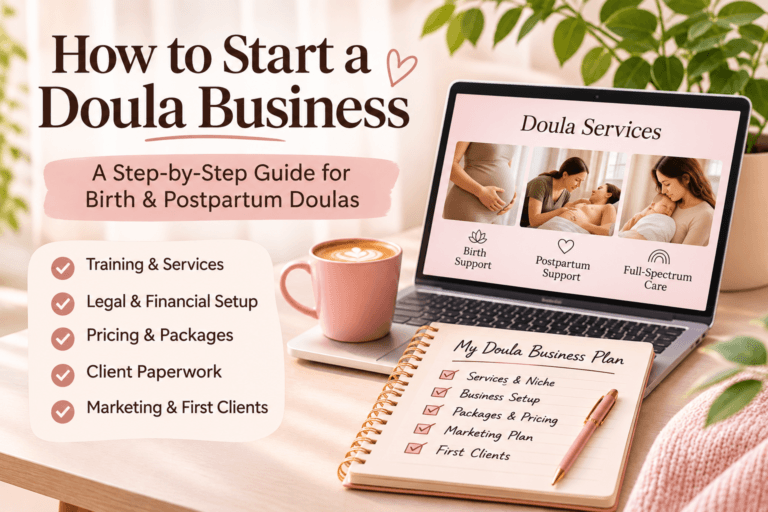
For the legal and practical setup, including business structure, licenses, insurance and taxes, how to start a doula business walks through each step in order.
Step 7: Decide which birth doula services you’ll offer
Define your packages clearly before you take your first client, so families know exactly what they’re booking. Two or three clear tiers are easier to explain than a long menu of options.
Here are two example packages you can adapt.
Basic Birth Support
- One prenatal meeting
- On-call availability around the due date
- Labor support
- Immediate postpartum support
Complete Birth Support
- Several prenatal meetings
- Birth preparation and birth preferences support
- Text or email support during an agreed period
- On-call availability around the due date
- Continuous labor support
- A postpartum follow-up visit
Step 8: Set your birth doula pricing
Set prices that cover your real costs and your time, including the hours you spend on call, and that make sense for your local market. Review your prices as your training, experience and demand grow.
Factors to weigh include your local market, your experience and training, travel, business expenses, availability and demand. How to price your doula services shows how to calculate your minimum price, build packages and talk about your rates with confidence.
Step 9: Create professional client documents
Every birth doula needs a few core documents before working with clients: a contract, an intake form and a clear way to invoice. These documents protect your time, set expectations and show families that you’re organized.
Documents most birth doulas use:
- A client contract
- A client intake form
- A birth preferences questionnaire
- Invoices and receipts
- A welcome guide
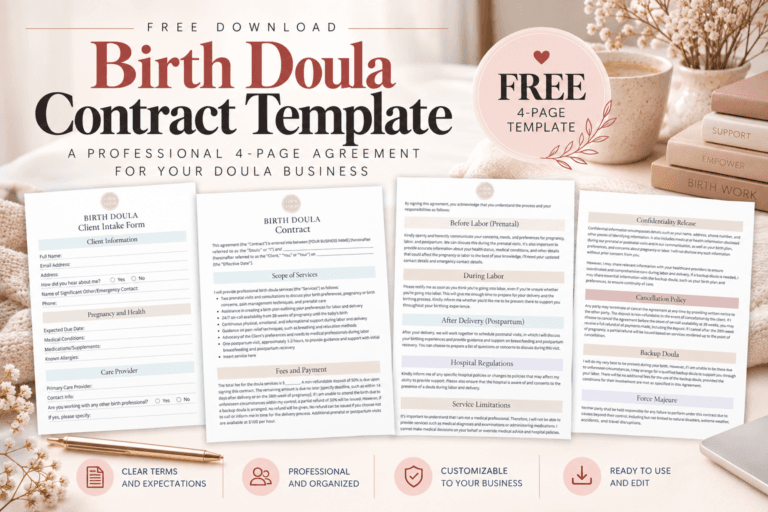
Your contract is the most important of these. What to include in a doula contract template explains every clause, from fees and on-call periods to cancellations, and you can start with a free birth doula contract template. Templates are not legal advice, so have your contract reviewed by a qualified local attorney before you use it.
Building every other form from scratch, right when you’re also trying to find clients, is where a lot of new doulas lose momentum. The Birth Doula Business Bundle gives you that complete onboarding set ready to customize in Canva: a 4-page contract, intake form, welcome booklet, birth preferences, questionnaire, invoice and receipt. Your first client receives paperwork that looks as prepared as you are, and you can put your energy into supporting families instead of formatting documents.
Step 10: Build a simple doula website
A simple website gives families one place to learn who you are, what you offer and how to contact you. It also gives other birth professionals somewhere to send families when they refer you.
A birth doula website usually needs:
- Home: who you help and where
- About: your story, training and approach
- Services: what each package includes
- Testimonials: shared with clients’ permission
- FAQ: answers to common questions
- Contact: a clear way to book a consultation
If building a site feels like a project you’ll keep postponing, a doula website template for birth and postpartum doulas lays out the homepage, about, services, package pricing, testimonials and contact sections in Canva. There’s no coding involved, so you can focus on your words and photos.
Step 11: Build a professional Instagram presence
Use Instagram to educate and build trust, not just to post pregnancy quotes. Helpful, consistent content shows families how you think and how you support people.
Content ideas for birth doulas:
- Birth preparation tips
- Labor positions and comfort techniques
- Common doula myths
- Answers to frequently asked questions
- Behind-the-scenes moments (with permission)
Set up your profile so it works like a mini website: a clear photo or logo, a short bio that says who you help, your service area, a call to action and a link to your website. A consistent visual style makes your profile easy to recognize. For a full plan across Instagram, Google and email, see how to market your doula business online.
Step 12: Find your first birth doula clients
Your first clients usually come from relationships, not ads. Start building your local network during training, and let people know when you’re ready to take clients.
People and places to connect with:
- Childbirth educators
- Lactation professionals
- Birth photographers
- Midwives and birth centers
- Parenting groups
- Other doulas, who may refer clients when they’re booked
Families may also find you through your website, Instagram, Google, doula directories, community events or workshops. How to get your first doula client breaks this into a step-by-step plan.
Step 13: Create a client onboarding process
A clear onboarding process gives every family the same smooth experience from first inquiry to final follow-up. It helps clients feel supported, and it makes your business feel established even when you’re new.
A simple birth doula client journey:
- Inquiry
- Discovery call
- Contract
- Deposit or payment
- Client intake
- Birth preferences
- Welcome guide
- Prenatal support
- Labor support
- Postpartum follow-up
Step 14: Protect your time and set boundaries
Set clear policies from the start and put them in writing, so families know what to expect and you can keep doing this work without burning out. Boundaries protect both you and your clients.
Policies to define:
- Communication hours and response times
- Payment terms
- Cancellations and refunds
- Scheduling and on-call periods
- Travel
- Backup doula support
- Your scope of practice
Step 15: Build a professional referral network
A referral network connects you with professionals who serve the same families at different moments. Over time, being known and trusted in your local birth community can become one of your strongest sources of clients.
Examples of referral relationships:
- Birth photographers who refer you, and you refer families to them
- Childbirth educators who recommend a doula to their classes
- Lactation professionals you refer to when families need specialized feeding support
- Prenatal fitness professionals
- Other doulas who can serve as backup, or take clients when you’re booked
How long does it take to become a birth doula?
There’s no single timeline. It depends on your training program, whether you pursue certification, how quickly you can attend births and your own pace.
The workshop itself may take a few days, but certification usually takes longer. DONA, for example, allows up to three years after the workshop to submit the certification packet, which gives you time to complete the required births, coursework and evaluations.
How much does it cost to become a birth doula?
Costs vary by program and location, so compare total costs, not just the workshop price. Expect to budget for more than training.
Common costs include:
- Training workshop and required courses
- Certification fees and any required membership
- Books and continuing education
- Insurance
- Business registration
- Website, marketing and software
- Supplies and comfort tools
Can you become a birth doula online?
Yes, many programs offer online or hybrid training. Hands-on experience is still usually part of becoming a confident doula, and certification often requires attending births in person.
If you choose an online program, confirm that it’s recognized by the organization you want to certify with, and ask how it supports you in getting practical experience.
What should a new birth doula focus on first?
Focus first on your training and confidence, then build a simple, professional business around them. You don’t need everything perfect before your first client.
Five priorities, in order:
- Training and practical experience
- Confidence in your skills and scope
- Business basics: services, pricing and paperwork
- Simple marketing so families can find you
- A smooth client experience
A simple birth doula business checklist
Use this checklist to see what’s ready and what still needs work.
- Training completed or in progress
- Scope of practice understood
- Packages defined
- Pricing set
- Contract ready (and reviewed locally)
- Intake form ready
- Onboarding process mapped out
- Payment method set up
- Website live
- Instagram profile set up
- A few pieces of marketing content
- Backup doula plan
- Referral network started
- Communication policies written
What other questions do people ask about becoming a birth doula?
Here are quick answers to common questions from aspiring birth doulas.
Do you need to be certified to work as a birth doula?
Certification is offered by doula organizations, and requirements for working as a doula can vary by employer, program and state. Check what your target agency, hospital program or state Medicaid program asks for before you start working with clients.
What are DONA’s birth doula certification requirements?
DONA’s published requirements include an approved birth doula workshop (16–24 hours), a childbirth education course (8 hours), a lactation support education course (3 hours), required reading, and continuous in-person labor support for three births with at least 15 total hours. The packet must be submitted within 3 years of the workshop, and DONA membership is required.
Do birth doulas need a medical background?
No. Birth doulas provide non-medical support, and DONA states that no prior medical background or degree is required. Doulas don’t give medical advice or perform clinical tasks.
What documents does a new birth doula need?
At minimum, a client contract, an intake form and a way to invoice. Many doulas also use a birth preferences questionnaire and a welcome guide. Have your contract reviewed by a qualified local attorney.
Can a birth doula also offer postpartum support?
Yes. Many birth doulas offer a postpartum follow-up visit, and some train as postpartum or full spectrum doulas too. See how to become a full spectrum doula if you’d like to support families across more experiences.
Your journey starts with one step
Becoming a birth doula starts with education, experience and a clear understanding of your scope. From there, building community and a simple, professional business lets you offer the kind of support you want families to remember.
You don’t have to do everything at once. Choose your training, attend your first births, and build your business one step at a time.