How to Get Your First Doula Client: The Complete Step-By-Step Guide for New Doulas
So you’ve finished your doula training, and you’re ready to support families. There’s just one problem: you don’t have a single client yet. This guide shows you how to get your first doula client, step by step, with examples you can use this week.
You’ll learn who to reach out to first, what you need in place before you market yourself, how to run a confident discovery call, and what to send the moment a family says yes.
The short answer: build trust before you spend money on ads. Here’s the path this guide follows:
- Define your ideal client and the services you offer.
- Set up a simple, credible online presence.
- Tell your personal network you’re accepting clients.
- Build referral relationships with local birth professionals.
- Decide whether to offer a free or discounted first spot.
- Use social media with a clear plan.
- Run a discovery call that ends with a clear next step.
- Use local search to stay visible over time.
Why is getting your first doula client so hard?
Getting your first doula client is hard because families are trusting you with one of the most personal experiences of their lives, and you don’t have testimonials, reviews or referrals to show yet. Until people know you, trust you and can find you, even excellent training won’t turn into bookings on its own.
New doulas often assume the missing piece is a better logo or a bigger website. In reality, families want to feel confident that you’re reliable, prepared and a good personal fit.
That means your first client usually isn’t won through a fancy logo or a perfectly designed website. It’s won through visibility, trust and consistent, intentional outreach. The eight steps below show you how to build all three.
Step 1: Who is your ideal doula client?
Your ideal client is the specific type of family you most want to support, defined by the kind of support they need, their birth or postpartum situation, and where they live. Naming them makes your marketing clearer, and it helps families quickly decide whether you’re the right fit.
“Doula” is a broad term. Are you a birth doula, postpartum doula, or full-spectrum doula? Do you want to work with first-time parents, families planning a hospital birth, families planning a home birth, or parents who want overnight newborn support?
If you’re still deciding which services to offer, read birth doula vs postpartum doula: what’s the difference? or our guide on how to become a full spectrum doula.
Compare these two introductions:
- Vague: “I’m a doula who helps with birth.”
- Clear: “I support first-time parents in [your city] who want calm, informed support during a hospital birth.”
The second version tells a family exactly who you help and where. To write your own, answer these questions:
- Who do I most want to support?
- What type of support do I offer (birth, postpartum or both)?
- Where do I serve clients (city, county or service radius)?
- What do those families worry about most, and how do I help?
Step 2: What do you need online before you start marketing?
You need a simple, credible place where families can learn who you are, what you offer, your general pricing and the area you serve. You don’t need a perfect website to get your first client, but you do need to be findable and look professional.
At minimum, set up:
- A simple website or a well-built business page on Instagram or Facebook that clearly lists your services, a pricing range or starting price, your service area, and how to contact you.
- A professional bio and a warm, approachable photo. Families hire people, not logos, so let them see who you are.
- A Google Business Profile so you can show up when families search for doulas near them. If you visit clients at their homes or birth locations instead of running a public office, Google’s guidelines for representing your business say that “if you’re a service-area business, you should hide your business address from customers.”
- Professional client paperwork, ready before anyone asks. That includes a contract, an intake form and an invoice.
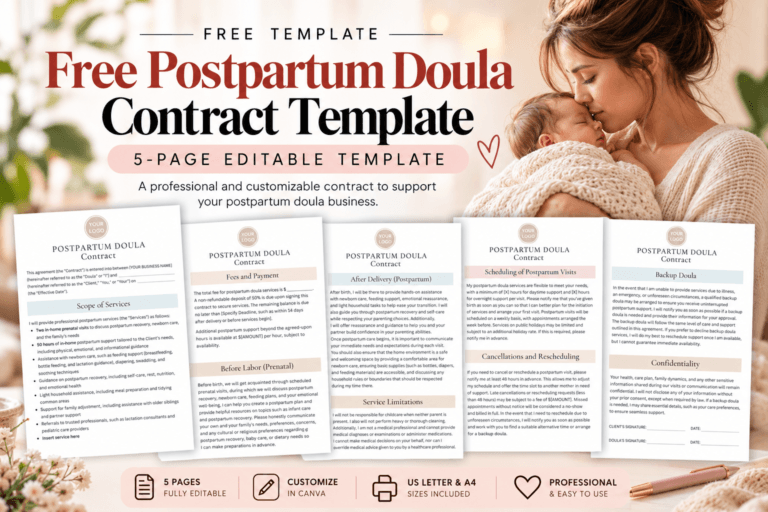
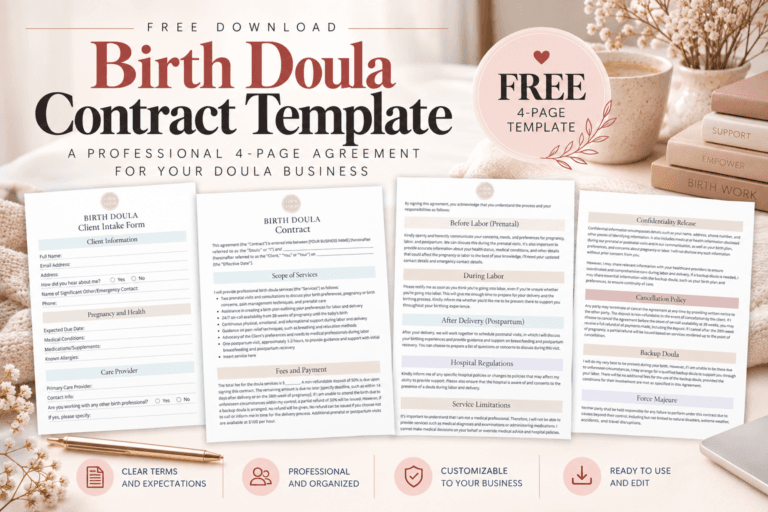
That last point is easy to overlook. When a family says yes, you want to send a clear, polished contract the same day, not scramble to write one. Our guide on what to include in a doula contract template walks through every clause, and you can start with our free birth doula contract template or postpartum doula contract template.
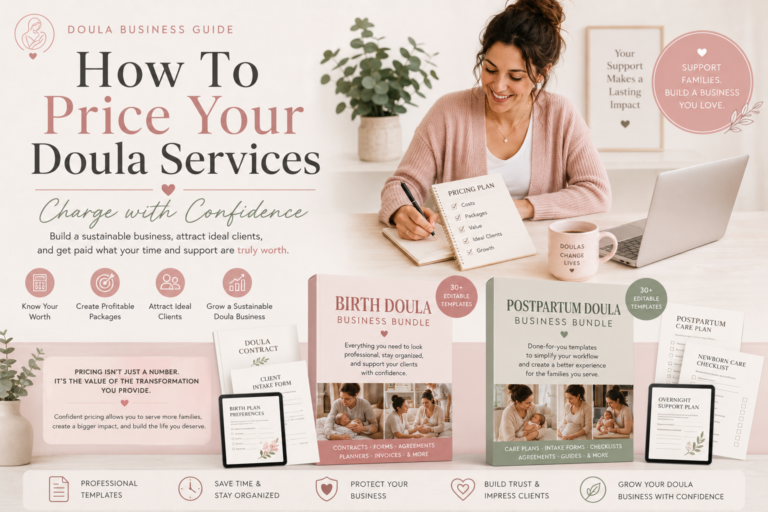
Want a ready-made website instead of building one from scratch? Our Doula Website Template is editable in Canva, includes sections for your services, package pricing, testimonials and contact details, and can be hosted for free on Canva.
For more ways to look established from the start, read how to be a professional postpartum doula from day one.
Step 3: Should you start with friends and family?
Yes. Your personal network is a natural place to start because the trust is already there, and the people in it can introduce you to expecting families you’d never reach on your own.
Before you spend money on ads, tell people you’re open for clients:
- Tell friends, family and former coworkers that you’re now a doula and accepting clients.
- Post about your new doula business on your personal social media, not just your business page.
- Let your own providers know, such as a chiropractor, massage therapist or yoga teacher you already see, in case their clients ask about doula support.
- Ask for introductions, not favors. Not everyone you tell will need a doula, but they may know someone who’s expecting.
Here’s a simple message you can adapt:
“Hi [Name]! I wanted to share some news: I’ve completed my doula training and I’m now accepting [birth/postpartum] clients in [area]. If you know anyone who’s expecting and might want extra support, I’d be so grateful if you’d pass along my name. Here’s where they can learn more: [link].”
Keep it short, warm and easy to forward. Then follow up personally with anyone who responds.
Step 4: How do you build referral relationships with local birth professionals?
Build referral relationships by introducing yourself to professionals who already work with expecting families, explaining exactly who you serve, and making it easy for them to recommend you. These relationships take time, but they can become a steady source of referrals.
Consider reaching out to:
- Local midwives and OB/GYN offices
- Childbirth educators and prenatal yoga instructors
- Lactation consultants (IBCLCs)
- Pediatric and prenatal chiropractors
- Local parenting groups and new-parent meetups
- Other doulas, who may need a backup doula or refer families when they’re fully booked
When you reach out, be specific and respectful of their time:
- Introduce yourself briefly: who you are, who you serve and your service area.
- Leave something useful: a business card or a one-page overview of your services.
- Offer value: for example, a free information session for a prenatal yoga studio’s clients.
- Follow up a few weeks later with a short thank-you or update.
Remember that doulas provide non-medical support. As Cleveland Clinic explains about doulas, “Doulas aren’t medical professionals and can’t provide treatment or medical advice.” Making your role clear helps care providers feel comfortable recommending you.
Step 5: Should a new doula offer a free or discounted birth?
It can help, as long as you set clear limits. Offering one or two free or reduced-fee spots can help you gain hands-on experience, earn your first testimonial and get introduced to that family’s friends, but only if the terms are agreed in writing.
Why some new doulas choose this:
- It lowers the financial risk for a family unsure about hiring a new doula.
- It gives you real-world experience you can describe in future marketing.
- It can lead to your first testimonial and personal referrals.
How to keep it professional:
- Use a written agreement, even for a free or discounted spot. Spell out your services, on-call period and communication expectations, just as you would for a paying client.
- Limit the number of spots, and set an end date for the offer.
- Ask for feedback openly. Request an honest testimonial, not a positive one.
- Be transparent about reduced-fee testimonials. The FTC’s endorsement guidance explains that when someone receives something of value in exchange for a review, that connection should be disclosed. If you share a testimonial from a free or discounted client, say so.
Not sure whether discounts make sense for you? See the section on whether new doulas should offer discounts in our guide on how to price your doula services.
Step 6: How should new doulas use social media to find clients?
Use social media to answer the questions expecting families are already asking, show your personality and expertise, and invite people to contact you. Posting without a plan rarely leads to bookings, so choose one or two platforms and post consistently.
A simple content plan for a new doula:
- Answer common questions: “What does a doula actually do?”, “Doula vs. midwife: what’s the difference?”, “When should I hire a doula?”
- Introduce yourself: why you became a doula, your training and who you love supporting.
- Share your services clearly: what’s included, your service area and how to book a consultation.
- Show real support moments, only with written permission, instead of relying on stock photos.
- Engage in local groups: join local pregnancy, due-date and parenting groups, follow each group’s rules, and help genuinely before you mention your services.
- Use local hashtags, such as #[yourcity]doula, alongside broader tags like #birthdoula.
Consistency matters more than perfection. A realistic schedule you can keep will do more for you than a few beautiful posts followed by weeks of silence.
Short on design time? Our Doula Instagram Post Templates Bundle includes 50 editable Canva templates, with educational, service-promotion and story templates designed for doulas. For a deeper strategy, read how to market your doula business online.
Step 7: How do you run a doula discovery call that turns into a booking?
Run your discovery call as a relaxed, structured conversation: learn what the family needs, explain how you can support them, answer their concerns, and end with one clear next step. The goal isn’t to sell hard. It’s to help the family decide confidently whether you’re the right fit.
This step can feel uncomfortable at first. It isn’t about birth knowledge. It’s about having a calm, organized conversation about your services and pricing.
A simple discovery call structure:
- Welcome and rapport (5 minutes). Thank them for reaching out and ask how they’re feeling about their pregnancy or postpartum period.
- Listen (10–15 minutes). Ask open questions and let them talk more than you do.
- Explain your support (5–10 minutes). Share what’s included in your package and how you work, connecting it to what they told you.
- Answer concerns. Address pricing, partner hesitation and “Do we really need a doula?” honestly and calmly.
- Agree on a next step. For example: “If you’d like to move forward, I’ll email you my contract and invoice today.”
Helpful questions to ask:
- “What made you start looking for a doula?”
- “What would make you feel most supported during birth (or after the baby arrives)?”
- “Who else will be supporting you?”
- “Do you have any worries you’d like to talk through?”
Avoid ending with a vague “Let me know!” Instead, tell them exactly what happens next and when you’ll follow up.
Want more help with marketing and positioning? Our How To Get Clients as a Doula Guide covers how to position yourself as a professional doula, build trust with potential clients online, get referrals and repeat clients, and avoid mistakes that may be stopping clients from booking.
Step 8: How can SEO help families keep finding you?
Search engine optimization (SEO) helps families find you when they search online for doula support in your area. Referrals and networking can bring in early clients faster, but local search can keep inquiries coming over time without constant outreach.
Start with the basics:
- Complete your Google Business Profile with your services and service area.
- Use location-based phrases naturally on your website, such as “birth doula in [city]” or “postpartum doula in [county].”
- Answer real questions families search for, such as what a doula does or how much a doula costs in your area.
- Ask happy clients for reviews, and respond to them professionally.
SEO is a long-term strategy, so don’t wait for it before reaching out personally. Our guide on how to market your doula business online covers SEO, Google Business Profile and content in more detail.
What should you do after your first client says yes?
Send your contract, invoice and intake form promptly, then welcome your client with clear information about what happens next. A smooth onboarding experience builds trust from day one and makes your new client more likely to recommend you.
A simple onboarding checklist:
- Contract: your services, on-call period, fees, backup plan, cancellation terms and signatures. Have a qualified local attorney review your contract before you use it, because most contract law comes from state law and rules can differ from state to state.
- Invoice and payment schedule: your deposit or retainer and when the remaining balance is due.
- Client intake form: contact details, due date, care providers and preferences.
- Welcome information: how and when to reach you, what to expect at each visit, and your next appointment.
- After the birth: ask for honest feedback, and request written permission before sharing a testimonial or photos.
If you’d rather not build all of this from scratch, our Birth Doula Business Bundle includes a 4-page birth doula contract, client intake form, welcome booklet, 3-page client questionnaire, photo and video release, liability waiver, confidentiality agreement, backup doula contract, and invoice, fees quotation, package pricing and receipt templates. Everything is editable in Canva, in US Letter and A4 sizes, and downloads as PDF, PNG or JPG.
Supporting families after birth? The Postpartum Doula Business Bundle includes a postpartum doula contract, client forms and 40+ editable templates to help you stay organized.
Our templates are customizable business resources, not legal advice.
What mistakes delay a new doula’s first client?
Mistakes that can delay your first client include waiting until everything feels perfect, undercharging out of fear, relying only on online marketing, avoiding conversations about pricing, and not following up. The good news is that each one is fixable.
Watch out for these:
- Waiting for a “perfect” website or brand before telling anyone you’re available.
- Pricing based on fear instead of value, which can lead to undercharging and burnout. Our doula pricing guide can help you set rates with confidence.
- Only marketing online and skipping local, in-person relationship building.
- Avoiding the sales conversation instead of preparing a simple discovery call structure.
- Not following up. A friendly follow-up message after a consultation helps families who are still deciding.
- Not having paperwork ready, so there’s a delay between a family saying yes and receiving a contract.
What does a 30-day first-client action plan look like?
A 30-day plan breaks your first-client marketing into small weekly tasks: get set up, tell your network, build local relationships, then follow up and refine. It turns a vague goal into actions you can check off.
| Week | Focus | Actions |
|---|---|---|
| Week 1 | Get set up | Define your ideal client, write your bio, set up your business page or website, and prepare your contract, intake form and invoice |
| Week 2 | Tell your network | Message friends, family and former coworkers, post on your personal social media, and ask for introductions |
| Week 3 | Build local relationships | Contact birth professionals, join local parenting groups, and offer a free information session |
| Week 4 | Follow up and refine | Follow up on every conversation, practice your discovery call, and review what’s bringing in inquiries |
Adjust the plan to fit your schedule. What matters is taking a few consistent actions every week.
What other questions do new doulas ask about getting their first client?
Here are quick answers to common questions from new doulas. Each one links to a deeper guide where it helps.
How long does it take to get your first doula client?
There’s no standard timeline, because it depends on your network, your area, the services you offer and how consistently you reach out. Focus on the actions you control each week, like outreach, follow-ups and referral relationships.
Do I need a website to get my first doula client?
No. A clear social media business page, a Google Business Profile and professional paperwork can be enough to start. A simple website helps families learn about your services and makes you easier to find over time.
How much should I charge my first doula client?
Your price should reflect your local market, your costs and the services you include, not just the fact that you’re new. Our guide on how to price your doula services walks through packages and pricing step by step.
What should I send a family after a discovery call?
Send a short thank-you message that recaps how you’d support them and the next step. If they’re ready to book, send your contract and invoice; if they’re still deciding, let them know when you’ll follow up.
How do I ask my first client for a testimonial?
Ask after your support is complete, and request honest feedback rather than a positive review. Get written permission before sharing it, and disclose it if the family received free or discounted services.
What’s the best first step to take today?
Tell five people you’re now accepting doula clients, and get your contract and intake form ready so you can respond professionally when someone says yes. Small, consistent actions build the trust that brings in your first booking.
Getting your first doula client is rarely about luck. It comes from visibility, consistency and genuine relationships. Start with your network, show up for local birth professionals, and make every conversation easy to say yes to.
Ready to Take the Next Step in Your Doula Business?
Finding your first doula client is an important milestone. Being prepared to support them professionally is just as important.
Whether you’re working on attracting your first inquiries or organizing your client onboarding process, having the right resources can help you move forward with greater clarity and confidence.
Explore the How to Get Clients as a Doula Guide for practical marketing strategies, or simplify your client paperwork with the Birth Doula Business Bundle, featuring customizable contracts, intake forms, and essential business templates.
Spend less time creating paperwork from scratch and more time building meaningful relationships with the families you serve.