How to Start a Doula Business in 2027
Starting a doula business is exciting, and it can also feel overwhelming when you’re not sure what comes first. This guide walks you through how to start a doula business step by step: choosing your services, setting up the legal and financial basics, planning your startup costs, preparing your client paperwork and finding your first families.
It’s written for new birth, postpartum and full-spectrum doulas in the United States. You don’t need a big budget or years of experience to begin. You need a clear plan and a few systems that make you look and feel professional from your very first inquiry.
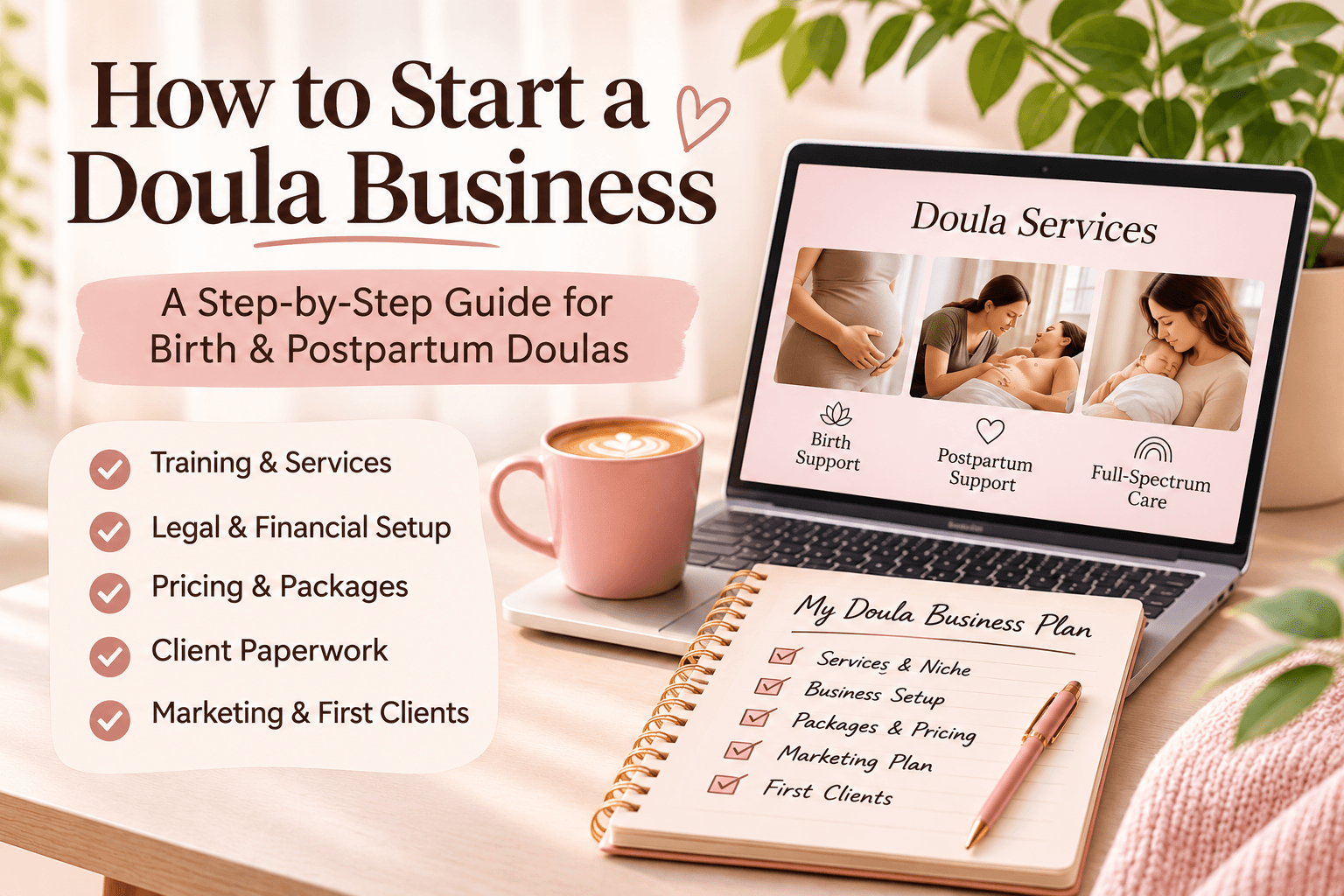
The short version: here’s the order this guide follows:
- Complete your doula training.
- Decide who you’ll serve and which services you’ll offer.
- Set up your business legally (structure, licenses, insurance and taxes).
- Plan your startup costs.
- Set your prices and packages.
- Prepare your client paperwork.
- Build your brand and online presence.
- Find your first clients.
What does a doula business involve?
A doula business provides non-medical emotional, physical and informational support to families during pregnancy, birth and the postpartum period, and runs like any other small business behind the scenes. You’re the support person, but you’re also the marketer, bookkeeper and client-care team.
That non-medical role is important to understand from day one. As Cleveland Clinic explains about doulas, “Doulas aren’t medical professionals and can’t provide treatment or medical advice.” Your services, marketing and paperwork should all reflect that.
Doula businesses commonly focus on one or more of these areas:
- Birth doula support during pregnancy, labor and birth
- Postpartum doula support for families in the weeks after birth
- Night doula support focused on overnight newborn care so parents can rest
- Fertility support for people navigating the path to conception
- Full-spectrum support across many reproductive experiences
Step 1: Have you completed your doula training?
Start with training that matches the type of support you want to offer, because it shapes your services, your confidence and how you describe yourself to families. Certification is a separate decision, and requirements vary by training organization and by how you plan to be paid.
If you’re still choosing a path, these guides go deeper:
- How to become a birth doula
- How to become a postpartum doula
- How to become a full spectrum doula
- Birth doula vs postpartum doula: what’s the difference?
Whatever you choose, describe your training and credentials accurately. Never call yourself certified until you are.
Step 2: Who will you serve, and what services will you offer?
Decide which families you most want to support and which services you’ll offer them. A clear focus makes every later step easier, from pricing your packages to writing your website.
Your niche can be based on the type of support, the families you serve or your approach. For example:
- Holistic birth support
- Faith-based doula services, such as Christian doula support
- Postpartum recovery and newborn support
- Support for first-time parents
- Natural birth support for families planning an unmedicated birth
Then turn your focus into clear services. Most doulas start with one or two packages, such as a birth support package with prenatal visits, labor support and a postpartum check-in, or a postpartum package built around a set number of support hours. Write down exactly what each package includes. You’ll use that list for your pricing, your website and your contract.
If you plan to offer feeding or lactation education, make sure your training covers it, and refer families to a lactation professional when they need more specialized help.
Step 3: How do you set up a doula business legally?
Choose a business structure, check which licenses or permits your state and city require, look into insurance, and understand your tax responsibilities before you take your first paying client. These basics protect you and make the rest of your business easier to run.
Business structure. According to the U.S. Small Business Administration’s guide to choosing a business structure, you’re “automatically considered to be a sole proprietorship” if you do business without registering as another type. The trade-off is that “you can be held personally liable for the debts and obligations of the business.” An LLC, by contrast, can “protect you from personal liability in most instances.” The SBA notes that “consulting with business counselors, attorneys, and accountants can prove helpful” when you decide.
Licenses and permits. The SBA explains that state and local requirements “will depend on your business activities and business location,” and suggests you “visit your Secretary of State’s website to find out which permits and licenses you need.” Check with your city or county too, especially if you’ll run the business from home.
Insurance. The SBA’s guide to business insurance describes professional liability insurance as coverage that “protects against financial loss as a result of malpractice, errors, and negligence,” and general liability as protection against claims involving “bodily injury, property damage, medical expenses.” It also notes that “laws requiring insurance vary by state.” Talk with an insurance agent about what makes sense for a doula business.
Taxes. If you’re self-employed, the IRS says “you usually must pay self-employment tax if you had net earnings from self-employment of $400 or more.” The IRS also says individuals, including sole proprietors, generally need to make estimated tax payments if “they expect to owe tax of $1,000 or more when their return is filed,” with the year divided into four payment periods. A few habits that help:
- Open a separate bank account for your business income and expenses.
- Keep receipts for business purchases, such as training, supplies and software.
- Set aside part of every payment for taxes.
- Ask a tax professional whether you need an Employer Identification Number (EIN) and how to handle estimated payments.
This section is general information, not legal, tax or financial advice. Rules vary by state, so confirm the details for your situation.
Step 4: How much does it cost to start a doula business?
Startup costs vary widely depending on your training program, your state’s requirements and how much you do yourself, so there’s no single reliable number. The most useful approach is to list each cost category, research the prices in your area and decide what you need before your first client.
| Cost category | What it covers | What to check |
|---|---|---|
| Training and certification | Your doula training program and any certification fees | Program cost, what’s included and renewal requirements |
| Business registration and licenses | LLC or business name registration, local licenses or permits | Your Secretary of State and city or county requirements |
| Insurance | Professional and general liability coverage | Quotes from an insurance agent |
| Website and email | Domain name, website platform and a professional email address | Monthly vs. yearly pricing |
| Client paperwork | Contracts, intake forms, invoices and welcome materials | Whether you’ll write them or customize templates |
| Marketing materials | Business cards, social media graphics and printed handouts | What you need for local networking |
| Support supplies | Comfort tools and resources you bring to clients | What your training recommends |
| Continuing education | Workshops and courses that build your skills | Your training organization’s requirements |
Add up the “must have before my first client” items first. Many of the rest can wait until your first few bookings help cover them.
Step 5: How should you price your doula services?
Price your services based on what’s included, the time you’ll commit (including on-call time), your business costs and your local market, not just on what feels comfortable as a new doula. Clear packages make it easier for families to say yes and easier for you to explain your value.
Before you set your prices, list:
- Every visit, hour and on-call day included in each package
- Your expenses, including taxes, insurance, travel and supplies
- What doulas with similar experience charge in your area
- How many clients you can realistically support each month
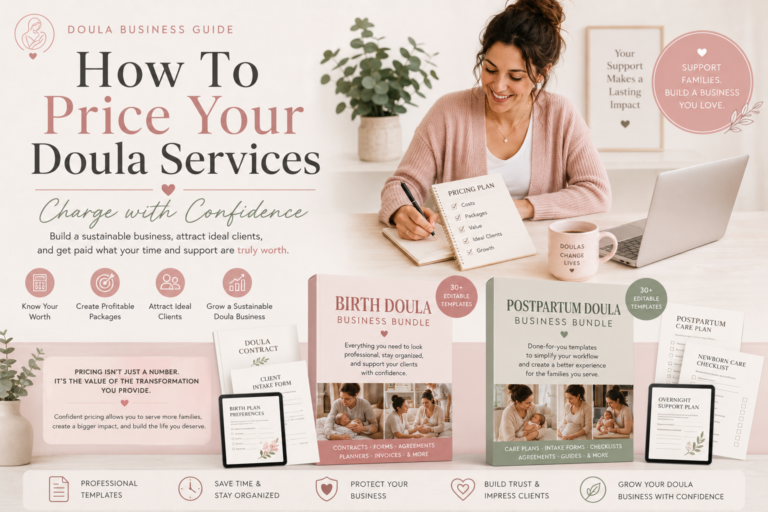
For a full walkthrough of packages, discounts and when to raise your rates, read how to price your doula services.
Step 6: What paperwork do you need before your first client?
Prepare your core client documents before your first consultation, so you can respond professionally the moment a family wants to book. Organized paperwork helps you communicate clearly and gives every family the same consistent experience.
Essential documents include:
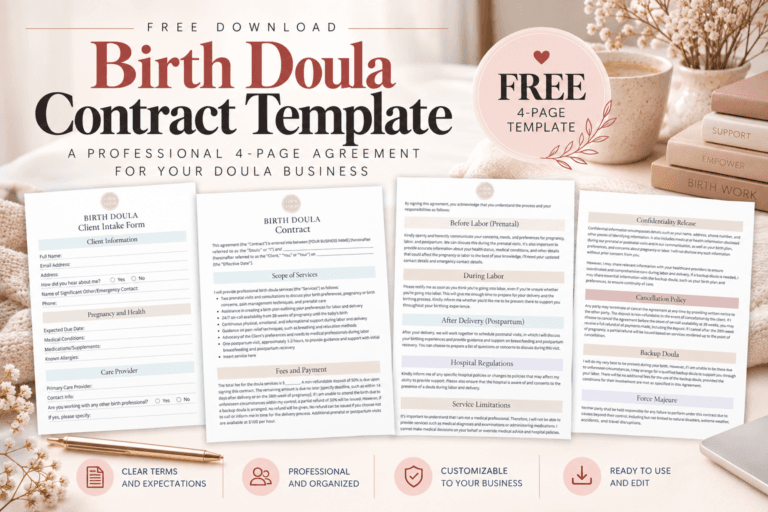
- Doula service contract: your services, fees, on-call period, backup plan and cancellation terms. See what to include in a doula contract template for a clause-by-clause walkthrough.
- Client intake form: contact details, due date, care providers and preferences, collected before your first visit.
- Client questionnaire: a deeper look at each family’s needs, hopes and concerns.
- Welcome booklet: what to expect, how to reach you and how your support works.
- Pricing guide: your packages and fees, presented clearly.
- Invoice and receipt templates: so payments are tracked and documented professionally.
This step can take longer than expected, because every document has to be written, designed and checked before you can use it. If you offer both birth and postpartum support, the Full Spectrum Doula Business Bundle gives you that entire foundation in one place. It includes birth and postpartum doula contracts, intake forms, welcome materials, client questionnaires, invoice and pricing templates, liability waivers, confidentiality agreements and backup doula contracts, all editable in Canva in US Letter and A4. Instead of spending your launch weeks building paperwork, you can focus on customizing it to your services and getting it reviewed. Doulas who focus on one specialty can start with the Birth Doula Business Bundle or the Postpartum Doula Business Bundle instead.
Whichever route you take, have your contract reviewed by a qualified local attorney before you use it with clients.
Step 7: How do you build your doula brand and online presence?
Create a simple, consistent brand that tells families who you are and who you help, then give them an easy place to find you online. Your brand doesn’t need to be elaborate. It needs to feel trustworthy, calm and clearly yours.
Start with the basics:
- Your business name and niche, stated clearly
- Brand colors and fonts you’ll use everywhere, from your website to your contracts
- Your tone of voice: warm and reassuring, practical and down-to-earth, or whatever fits you
- A short description of who you serve and where
Then set up your online presence:
- A website with Home, About, Services, Testimonials, Contact and Blog pages, plus a clear “Book a consultation” button
- A Google Business Profile so local families can find you on Google and Maps
- One or two social media platforms you can keep up with consistently
Use your location naturally on your website, with phrases like “postpartum doula in [your city]” or “birth doula serving [your county].” If building a site from scratch feels like a project you’ll keep putting off, a Canva-editable doula website template comes with homepage, about, services, testimonials and contact sections already laid out, so you can launch by adding your own words and photos.
For a full plan covering your website, Google Business Profile, social media, email and reviews, read how to market your doula business online.
Step 8: How will you find your first doula clients?
Start with people who already know you, build relationships with local birth professionals, and share helpful content so families get to know you before they reach out. Early clients often come from trust and visibility rather than ads.
A few ways to start:
- Tell your network that you’re now accepting clients, and ask for introductions.
- Connect with local professionals who work with expecting families, such as midwives, childbirth educators and lactation consultants.
- Write helpful blog posts that answer families’ questions, such as “What does a birth doula do?”, “How can partners support labor?” or “What should I pack in my hospital bag?”
- Offer a free resource, such as a birth preferences worksheet or a hospital bag checklist, and invite people to join your email list.
How to get your first doula client covers outreach, referrals and running a confident discovery call in detail.
Should you look into Medicaid coverage for doula services?
Yes, it’s worth checking. Most states have taken steps toward covering doula care through Medicaid, which could make your services available to more families in your area. A Georgetown University Center for Children & Families article cites a National Health Law Program tracker of “the 46 states and D.C. that have taken steps toward Medicaid coverage for doula care.” That figure was last updated in May 2025.
Each state runs its program differently, and programs are still changing. If you’re interested, contact your state Medicaid agency to learn whether doula services are covered, what doulas must do to enroll, and how reimbursement works.
Doula business startup checklist
Use this checklist to track your progress:
- Training completed for the services you’ll offer
- Niche and service packages defined in writing
- Business structure chosen, with any registration completed
- Local licenses and permits checked
- Insurance quotes reviewed
- Separate business bank account opened
- Tax plan in place, including estimated payments
- Prices set for each package
- Contract, intake form, questionnaire, welcome booklet and invoice ready
- Contract reviewed by a local attorney
- Brand basics, website and Google Business Profile set up
- First outreach messages sent to your network
What other questions do new doulas ask about starting a business?
Here are quick answers to common questions about starting a doula business.
Do I need to be certified to start a doula business?
It depends on your training organization and how you plan to be paid. If you plan to work with Medicaid or other programs, check their requirements before you start. Whatever your path, describe your training accurately.
Do I need an LLC to start a doula business?
Not necessarily. According to the SBA, you’re automatically treated as a sole proprietor if you don’t register another structure, but sole proprietors can be personally liable for business debts. An LLC can offer liability protection, so ask an attorney or accountant which structure fits you.
Do doulas need insurance?
Insurance laws vary by state, so there’s no single answer. Professional and general liability coverage are both worth asking about, so talk with an insurance agent about what makes sense for your services.
Can I run a doula business from home?
The business side of a doula practice can often be run from home, since support usually happens at the client’s home or birth location. Check your city or county’s rules for home-based businesses, and ask your insurance agent whether your home insurance covers business activities.
How long does it take to start a doula business?
It depends mostly on your training timeline. Many business setup steps, like choosing a structure, setting up your brand and preparing paperwork, can be done while you finish your training.
What should you do first?
Finish or confirm your training, then write down exactly who you’ll serve and what each package includes. Almost every other decision, from pricing to paperwork to your website, builds on those two answers. Then work through the checklist one item at a time. You don’t need a perfect business on day one. You need a solid foundation and the confidence to welcome your first family professionally.