Doula Contract Template: What to Include, Clause by Clause
A good doula contract template turns a friendly consultation into a clear, professional agreement. It spells out what you’ll do, when you’re available, what it costs and what happens if plans change, so you and your clients start on the same page.
This guide walks through every clause, one at a time. Whether you’re writing your first contract or tightening one you’ve used for years, you’ll know exactly what belongs in it.
Important: This guide is general business information, not legal advice. Contract rules vary by state, so have a qualified local attorney review your contract before you use it with clients.
What is a doula contract?
A doula contract is a written service agreement between you and your client that sets out your services, fees, schedule and boundaries. It protects both sides by putting expectations in writing before you’re on call.
In legal terms, a contract is “an agreement between parties, creating mutual obligations that are enforceable by law”. For your doula business, that means the document families sign should match what you actually promise and deliver.
You’ll also see it called a doula services agreement, a client contract or a letter of agreement. The name matters less than what’s inside.
What should be in a doula contract template?
A complete doula contract template covers who’s involved, what services you provide (and don’t), your availability, your fees and payment schedule, your backup plan, cancellation and refund terms, confidentiality and signatures. Each clause answers a question your client would otherwise have to ask you later, often at the worst possible moment.
Here’s the full checklist at a glance. Each clause is explained in its own section below.
| Clause | What it covers | Why it matters |
|---|---|---|
| Parties and contact details | Your business name, the client’s name, due date, how to reach you | Makes it clear who the agreement is between |
| Scope of services | Visits, labor support, postpartum visits, phone and text support | Sets expectations about what’s included |
| Non-medical role | What a doula does not do | Keeps your role clear for clients and care teams |
| On-call period | The dates you’re available 24/7 for labor | Prevents confusion about when to call you |
| Fees and payments | Package price, deposit or retainer, due dates, payment methods | Protects your income and avoids awkward reminders |
| Backup doula | Who attends if you can’t, and how that’s handled | Reassures clients there’s a plan |
| Cancellation and refunds | What happens if either side ends the agreement, or birth plans change | Reduces disputes when things change |
| Confidentiality and photos | Privacy of client information, and permission for photos or testimonials | Builds trust and protects client privacy |
| Signatures and dates | Both parties sign and date | Shows both sides agreed to the terms |
You’ve probably already decided most of these. The contract simply writes them down so they’re consistent for every family you serve.
How do you describe your scope of services and what a doula doesn’t do?
List exactly what’s included in each package: the number of prenatal and postpartum visits, when continuous labor support begins, and how clients can reach you by phone, text or email. Then add a short, plain-language statement that you provide non-medical support only.
That second part is essential. As Cleveland Clinic explains about doulas, “Doulas aren’t medical professionals and can’t provide treatment or medical advice.” Saying this clearly in your contract helps clients understand your role alongside their doctor or midwife.
A clear scope clause typically answers:
- What’s included: visits, labor and birth support, postpartum check-ins, resources you share
- How you communicate: which channels you use and your typical response times outside the on-call window
- What’s not included: clinical tasks, medical decisions, or services you don’t offer (such as overnight care, if you don’t provide it)
Be specific. “Two prenatal visits of about 90 minutes each” is far clearer than “prenatal support.”
When does a birth doula’s on-call period start?
Your on-call period starts on the date you set in your contract. There’s no universal rule, so choose a window that fits your practice and write it as a clear date range.
State when you go on call, when it ends (usually the birth or a set date afterward), and how clients should contact you in early labor. If you limit how many clients you take per month to protect your availability, say so here too.
Also include what happens before your on-call window opens. For example, explain how you’ll handle an early labor call and whether your backup plan applies.
What happens if your doula can’t make the birth?
Your contract should explain exactly what happens if you can’t attend, whether that’s illness, an emergency or two births at once. Usually that means a backup doula attends in your place, and the contract says how clients will meet her and how fees are handled.
A strong backup doula clause covers:
- When a backup may attend: illness, emergencies, overlapping births or travel issues
- Who the backup is: a named doula or a trusted network, and whether clients meet her beforehand
- How fees work: whether anything changes for the client if the backup attends
You may also want a separate agreement with the backup doula herself, covering availability, pay and confidentiality. If you work with backups regularly, it’s worth keeping that paperwork separate from your client contract.
How should doula fees, deposits and final payments be structured?
Your fees clause should list the total package price, any non-refundable deposit or retainer, every payment due date and the payment methods you accept. Writing it all down up front means you won’t have to chase payments while you’re supporting a family.
Keep it simple and specific:
- Package name and total fee
- Deposit or retainer amount, when it’s due, and whether it’s refundable
- Remaining balance and its due date
- Accepted payment methods and any late-payment terms
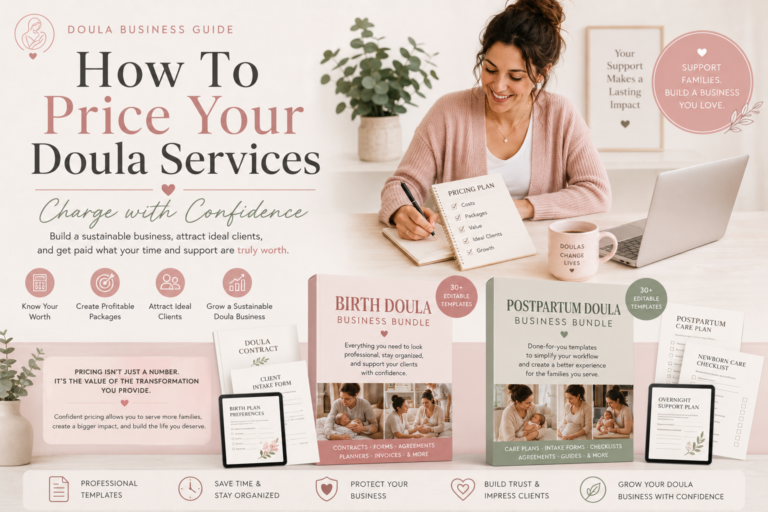
If you’re still deciding what to charge, our guide on how to price your doula services walks through packages and pricing step by step. Once your prices are set, put them in your contract exactly as you quote them.
What cancellation and refund terms should a doula contract include?
Your cancellation clause should say what happens if the client ends the agreement, if you need to end it, and what’s refunded in each case. It should also cover situations where the birth doesn’t go as expected, so neither side is surprised.
Consider addressing:
- Client cancellation: how much notice is needed and what’s refunded at each stage
- Doula-initiated cancellation: when you might end the agreement and how refunds work
- A very fast birth: what happens if labor moves so quickly that you can’t arrive in time
- A scheduled cesarean or changed birth plan: whether services and fees change
- Facility restrictions: what happens if a hospital or birth center limits who can attend
These are business decisions, and there’s no single right answer. Whatever you choose, write it in plain language and ask your attorney whether your refund terms work under your state’s laws.
Should a doula contract include confidentiality and photo release clauses?
Yes. A confidentiality clause explains how you protect your client’s personal information, and a separate photo or video release asks permission before you share any birth photos or testimonials.
Keep these as clear, separate sections or forms. Clients should be able to sign your service agreement without automatically agreeing to have photos shared. A clear opt-in makes trust easier.
If you collect testimonials for your website or social media, put that permission in writing too.
How is a postpartum doula contract different from a birth doula contract?
A birth doula contract centers on the on-call period, labor support and a set number of prenatal and postpartum visits. A postpartum doula contract is usually built around scheduled hours: daytime or overnight shifts, minimum bookings, hourly or package rates, and what household tasks are included.
Here’s how the focus shifts:
- Birth doula contracts emphasize the on-call window, backup doula coverage, labor support and what happens with fast or changed births.
- Postpartum doula contracts emphasize scheduling, shift length, rescheduling and cancellation notice, and clear boundaries around which household or baby-care tasks are part of your support.
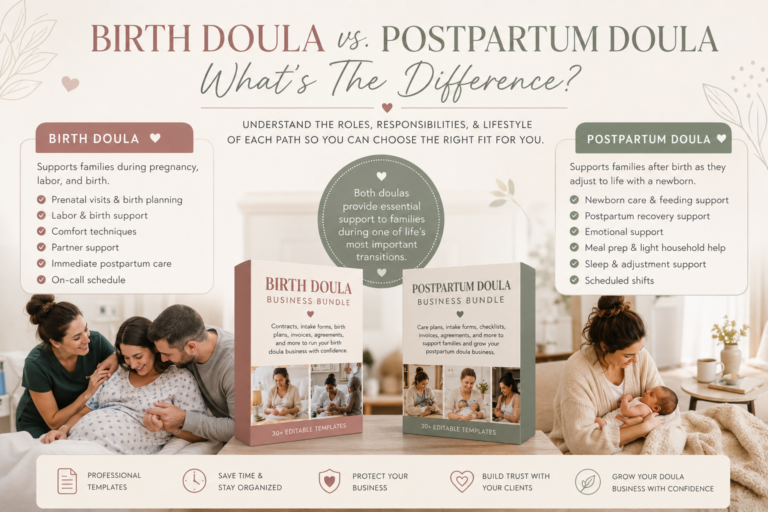
If you’re still deciding which services to offer, read birth doula vs postpartum doula: what’s the difference. If you want a starting point for either type, we have a free birth doula contract template and a free postpartum doula contract template you can download today.
Where can you get a free doula contract template?
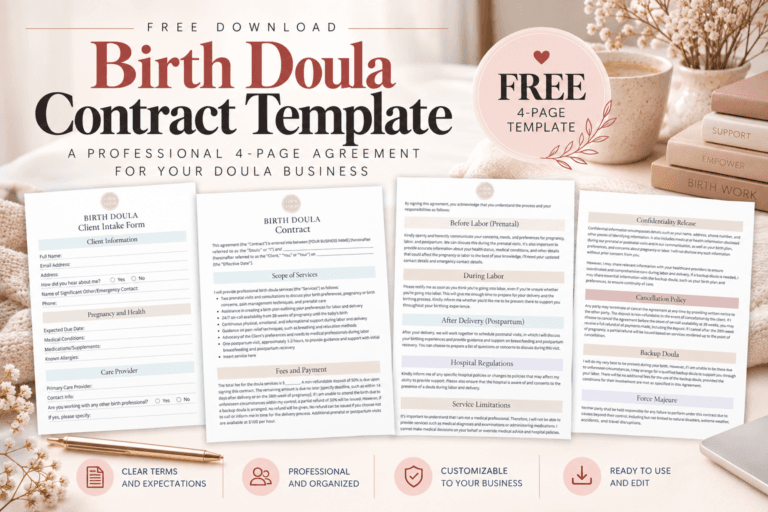
You can download a free 4-page birth doula contract template or a free 5-page postpartum doula contract template from MyDoulaTemplates. Use either as a starting point, then customize it for your services and have it reviewed by a local attorney.
A free sample doula contract is a great way to see how a professional agreement is structured. When you’re ready for a complete, client-ready set of paperwork, the business bundles go further, as explained below.
Word, PDF or Canva: which doula contract template format is best?
The best format is the one you can edit easily and send to clients in a clean, professional file. One simple workflow: edit a Canva template, export it as a PDF, and send it for signature.
Here’s how the common options compare:
- Word or Google Docs: easy text edits, but harder to keep a polished, branded design
- Printable PDF: clean to print and sign by hand, but harder to edit without the original file
- Canva-editable: easy to brand with your logo, colors and fonts, then export to PDF to print or send
What about signing online? Under the federal ESIGN Act, a contract “may not be denied legal effect, validity, or enforceability solely because an electronic signature or electronic record was used in its formation.” There are exceptions and consumer-disclosure rules, so confirm your e-signature process with your attorney.
What makes a doula contract template easy to customize?
A template is only useful if you can adapt it quickly to your own services, prices and policies without breaking the layout. Look for clearly labeled sections, plain language you can edit line by line, and a design that still looks professional after you’ve made it yours.
We want to be clear about what our templates are, too. They’re customizable business resources, not legal advice. We recommend a local attorney review before you use any contract.
If you’d rather not build every document from scratch, our Birth Doula Business Bundle includes a ready-to-use 4-page birth doula contract alongside a backup doula contract, a liability waiver, a confidentiality agreement, a photo and video release, a client intake form, and invoice, quote and receipt templates. Everything is Canva-editable in US Letter and A4, exports to PDF, PNG or JPG, and downloads instantly.
Supporting families after birth? The Postpartum Doula Business Bundle includes a postpartum contract plus client forms and Canva-editable templates to help you stay organized.
Should a lawyer review my doula contract template?
Yes. Have a qualified local attorney review your doula contract before you use it, because contract rules aren’t identical everywhere, and no single template is written for every state.
According to Cornell Law School’s Legal Information Institute, “most contract law derives from state common law”, and “state courts may interpret individual elements differently.” An attorney who knows your state can check your cancellation terms, refund policy, liability language and signature process.
Not sure where to start? State and local bar associations typically offer lawyer referral services. A one-time review of your base contract is an investment you can reuse with every client.
What other questions do doulas ask about contract templates?
These are the quick answers to the questions that come up most often once your main contract is drafted. For anything specific to your state, check with your attorney.
Is a doula contract legally binding?
A signed contract can be enforceable, but whether yours is depends on how it’s written and on the law in your state. Have a qualified local attorney review your contract before you use it with clients.
Can clients sign a doula contract electronically?
Under the federal ESIGN Act, a contract can’t be denied legal effect solely because it’s electronic or was signed electronically. There are exceptions and consumer-disclosure rules, so confirm your e-signature process with your attorney.
How long should a doula contract be?
There’s no required length. A contract should be long enough to cover your services, schedule, fees, backup and cancellation terms clearly, and short enough that clients actually read it before they sign.
Should I use the same contract for every client?
Use one base template for consistency, then update the client-specific details for every family, such as names, due date, package, fees and payment dates. If you offer very different services, keep a separate version for each.
Do I need a separate contract for a backup doula?
Your client contract should explain when a backup doula may attend. You may also want a separate agreement with the backup doula herself, covering availability, pay and confidentiality.
Ready to Take the Next Step in Your Doula Business?
A well-structured contract is more than just paperwork. It helps you set clear expectations, establish professional boundaries, and create a smoother experience for both you and the families you support. But your contract is just one part of running an organized, professional doula business.
Instead of spending hours creating contracts, client forms, and essential business documents from scratch, you can start with professionally designed templates that are ready to customize and make your own.
Our Birth Doula Business Bundle brings your essential business paperwork together in one place, with Canva-editable templates designed to help you save time, stay organized, and focus more on supporting your clients.
Spend less time on paperwork. More time doing the work that matters.