How To Become A Postpartum Doula: A Complete Step-by-Step Guide
Thinking about how to become a postpartum doula? Postpartum doulas support families in the days, weeks and sometimes months after a baby arrives, with practical help, emotional support and newborn care education. It’s meaningful work, and it’s also a business you’ll need to set up with care.
This guide walks you through each step in order: understanding the role, choosing training, certification, building skills and experience, and then the business side, from packages and pricing to paperwork, branding and your first clients.
What is a postpartum doula?
A postpartum doula is a trained, non-medical support person who helps families recover, adjust and feel confident caring for their newborn after birth. Postpartum doulas don’t diagnose or treat medical conditions. They support families and refer them to healthcare professionals when needed.
As Cleveland Clinic explains about doulas, “Doulas aren’t medical professionals and can’t provide treatment or medical advice.” Within that scope, a postpartum doula’s support may include:
- Newborn care education
- Feeding support, within the doula’s training
- Practical and emotional support during recovery
- Light household help and simple meal preparation
- Soothing techniques and help building routines
- Helping older siblings adjust
- Postpartum planning
- Referrals to healthcare providers, lactation consultants and other professionals
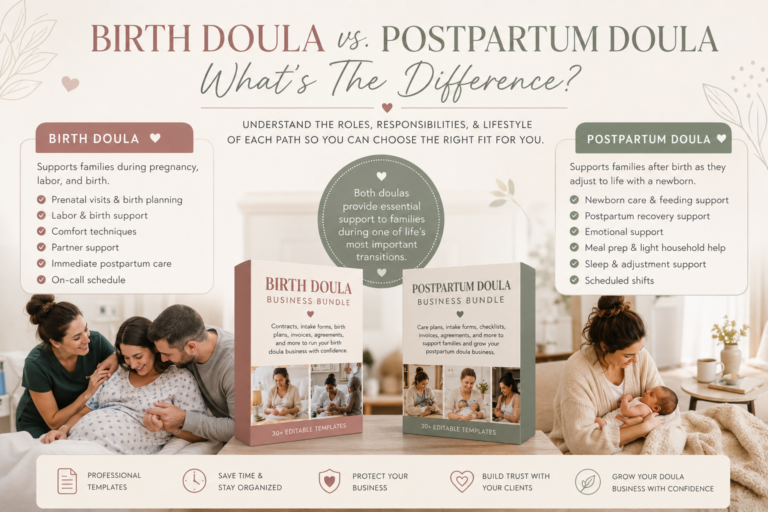
The exact services vary with each doula’s training, experience, location and business model. If you’re still choosing between paths, birth doula vs postpartum doula: what’s the difference? compares the two roles side by side.
What does a postpartum doula do day to day?
A postpartum doula’s day centers on helping parents feel rested, capable and supported, through a mix of newborn support, parent support and light household help. Some postpartum doulas work daytime shifts, while others specialize in overnight support.
Newborn support
You might help parents with soothing techniques, feeding routines, diapering, sleep routines and babywearing, and explain what normal newborn behavior looks like. The goal is to build the parents’ confidence, not to take over.
Parent support
Emotional support is a big part of the work: encouragement, non-judgmental listening and help adjusting to new routines. New parents often just need someone calm in the room.
Household support
Many postpartum doulas prepare simple meals, organize baby items, do baby laundry and handle light tasks. A postpartum doula isn’t a housekeeper, though. The point is to reduce practical pressure so parents can focus on recovery and bonding.
Step 1: Learn what postpartum doulas actually do
Before you invest in training, get a clear picture of the role and whether it fits your life. Understanding the work first helps you choose the right training and avoid surprises later.
Things to research:
- Your scope of practice, and what’s outside it
- The types of families you’d like to support
- Daytime versus overnight work
- What clients usually expect
- How postpartum doulas communicate with families and set boundaries
Step 2: Choose your postpartum doula training
Choose a program whose curriculum, practical requirements and values fit the kind of postpartum doula you want to be. The most expensive program isn’t automatically the best fit for you.
DONA International’s postpartum doula certification is one well-known example. Its published pathway starts with a “DONA-approved postpartum doula workshop (27+ hours).” Other organizations structure their training differently, so compare a few before you decide.
When comparing programs, look at:
- Newborn care, recovery and feeding education
- How emotional support and scope of practice are taught
- Whether business education is included
- Practical experience requirements
- Certification requirements and continuing education
- Total cost, including fees, books and any membership
- Format: online, in person or hybrid
Step 3: Consider postpartum doula certification
Certification shows you’ve met a specific organization’s requirements, and requirements vary from one organization to another. It’s separate from training, and you should only call yourself certified once you’ve completed it.
As an example, DONA’s postpartum certification requires you to “Provide postpartum support for at least 3 families within 12 weeks after birth,” with a “Minimum of 12 hours and a minimum of 3 visits per family of total service for each family supported (36 hours total across 3 families).” The certification packet “Must be submitted within 3 years of workshop completion,” includes client evaluations, a community resource and referral list, a self-assessment and scope of practice and code of ethics agreements, and “DONA International membership required for packet submission.”
Other organizations may ask for different things, such as reading, assignments, CPR or first-aid training, or continuing education. Check the current requirements directly with the organization you choose.
Step 4: Build your postpartum doula skills
The skills families value most are about how you show up for them. Strong practical knowledge matters, but so does how calm, kind and organized you are.
Six skills to build from the start:
- Communication. Speaking clearly and listening carefully.
- Empathy. Supporting families without judgment.
- Organization. Helping families build routines that work for them.
- Flexibility. Every family, home and baby is different.
- Professional boundaries. Knowing the difference between support and medical care, and when to refer.
- Confidence. Families need to trust that you know what you’re doing.
Step 5: Gain experience
Practical experience turns training into confidence. If your program requires client experience, complete it as your program describes, and keep learning alongside it.
Other ways to build experience:
- Workshops and continuing education
- Practicing newborn care skills
- Learning about different feeding approaches, within your training
- Studying postpartum recovery
- Connecting with experienced postpartum doulas
- Joining professional doula communities
Step 6: Decide which postpartum doula services you’ll offer
Choose a focused set of services rather than trying to offer everything. A clear offer is easier for families to understand and easier for you to deliver well.
Common postpartum doula services:
- Daytime postpartum support: visits of several hours during the day.
- Overnight postpartum support: help during the night so parents can rest.
- Newborn care support: building parents’ confidence with routines and care.
- Postpartum recovery support: non-medical practical and emotional help.
- Feeding support: educational and emotional support, if you’re trained in it.
Step 7: Create your postpartum doula packages
Packages make your services easier to understand and book than an hourly rate alone. They also help families plan and budget, and make your income more predictable.
Here are three example packages you can adapt.
Basic Postpartum Support
- 10 hours of support
- Newborn care education
- Parent support
- Light household help
Extended Postpartum Support
- 20 hours of support
- Newborn and feeding support
- Parent education
- Simple meal preparation
- Additional resources
Overnight Support Package
- Overnight support
- Newborn care assistance
- Rest periods for parents
- Help with routines
Shape your packages around your location, experience, services, availability and costs.
Step 8: Set your postpartum doula pricing
There’s no universal rate for postpartum doulas. Your price should reflect your local market, your experience and the true cost of running your business, including the time no one sees.
Factors to include when you set your rates:
- Your hourly rate and the hours each client needs
- Travel time and transportation
- Business expenses, including insurance and training
- Taxes
- Admin, marketing and communication time
- Day versus overnight availability
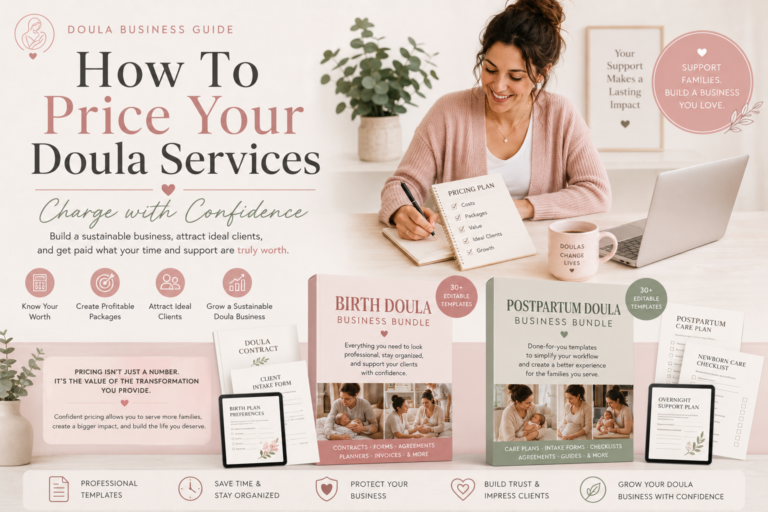
Rather than copying another doula’s prices, calculate what your business needs to be sustainable. How to price your doula services shows how to work out your minimum price, set hourly and overnight rates, and build postpartum packages.
Step 9: Create professional client documents
Professional client documents give every family the same clear, organized start. They set expectations, protect your time and make your business feel established, even with your first client.
Documents many postpartum doulas use:
- A contract or service agreement
- A client intake form
- A postpartum plan and questionnaire
- A confidentiality agreement
- A photo and video release
- A backup doula agreement
- Invoices and payment receipts
- A welcome booklet and client resources
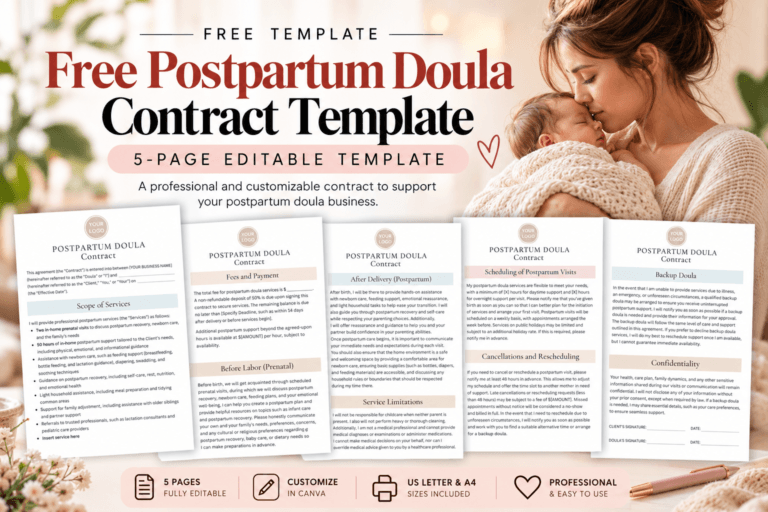
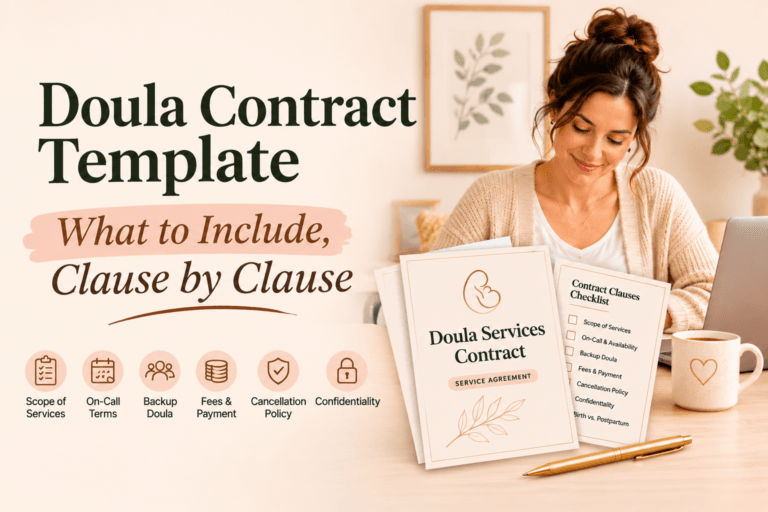
Your contract is the foundation. You can start with a free postpartum doula contract template, and what to include in a doula contract template explains each clause, from scheduling to cancellations. Templates are not legal advice, so have your contract reviewed by a qualified local attorney before you use it.
Creating each of these from scratch, while you’re also finishing training and looking for clients, is where many new doulas lose weeks. The Postpartum Doula Business Bundle gives you the onboarding essentials ready to customize in Canva, including a postpartum contract, client intake form, welcome booklet, liability waiver and invoices. Your first family gets a polished, consistent welcome, and you get your evenings back.
Step 10: Create your doula brand
Your brand is how families recognize and remember you, and it’s much more than a logo. A consistent look and tone across everything you share helps you appear trustworthy and established.
Brand elements to keep consistent:
- Business name and logo
- Colors and fonts
- Photography style
- Website and social media
- Client documents, business cards and welcome materials
Step 11: Build a professional doula website
A website gives families one place to learn who you are, what you offer and how to book. It also gives birth doulas, lactation professionals and other partners somewhere to send families when they refer you.
Your postpartum doula website should show:
- Who you are and who you help
- Your services and service area
- Your packages, and a starting price if you choose to share one
- Your training and experience
- Your contact details and how to book a consultation
If building a site keeps slipping down your to-do list, a doula website template for birth and postpartum doulas lays out the homepage, about, services, package pricing, testimonials and contact sections in Canva. There’s no coding involved, and it can be hosted for free on Canva.
Step 12: Build a professional Instagram presence
Instagram helps families get to know you before they reach out, so treat it as a place to educate and build trust rather than only to advertise. Your profile should make it obvious who you help, what you offer, where you work and how to contact you.
Content ideas for postpartum doulas:
- Newborn care tips
- Postpartum recovery basics
- Preparing for the postpartum period
- Feeding education, within your training
- Answers to frequently asked questions
- Your services and what’s included
- Behind-the-scenes moments
Mix formats to keep your feed helpful and personal:
- Educational posts: what parents can prepare before the baby arrives.
- Carousels: a first-week postpartum checklist.
- Reels: what parents wish they knew about the postpartum period.
- FAQ posts: “Do postpartum doulas stay overnight?”
- Personal content: why you became a postpartum doula.
Consistency in colors, fonts, layout and tone matters more than perfect photos, and it’s the hardest part to keep up when every post needs its own design. The Doula Instagram Post Templates Bundle gives you 50 editable Canva templates for educational posts, service promotion, trust-building content and stories, so your feed stays recognizably yours. For a full plan beyond Instagram, see how to market your doula business online.
Step 13: Find your first postpartum doula clients
Your first clients usually come through relationships, not ads. Get to know the professionals who already work with new and expecting parents, and build real relationships before you ask for referrals.
People and places to connect with:
- Midwives and healthcare providers
- Lactation professionals
- Childbirth and prenatal educators
- Birth doulas
- Parenting groups and pregnancy organizations
- Baby stores and community organizations
How to get your first doula client turns this into a step-by-step plan.
Step 14: Build a referral network
A referral network connects you with professionals whose clients need what you offer. The goal is to become someone others feel comfortable recommending.
Examples of natural referral partners:
- A birth doula whose clients need support after the birth
- A lactation professional whose families need extra help at home
- A childbirth educator whose students are planning for the postpartum period
Step 15: Ask for reviews and testimonials
Feedback from past clients helps you improve and helps future families trust you. Ask every client, not just the ones you expect to be happy, and get permission before you share anything publicly.
Questions you could ask:
- How did my support help you?
- Did you feel more confident with your baby?
- Would you recommend my services to a friend?
Get written permission before publishing a client’s name, photo or testimonial. If you collect Google reviews, follow Google’s review policies, which don’t allow incentivized reviews or asking only happy clients for reviews.
Step 16: Create a professional client experience
Map out every step a family takes with you, from first inquiry to final follow-up, so each client gets the same organized experience. Clear steps set expectations and cut down on repeated questions.
A simple postpartum client journey:
- Inquiry
- Consultation
- Contract
- Payment
- Intake form
- Postpartum plan
- Welcome materials
- Support visits
- Follow-up
For more on systems, communication and boundaries, see how to be a professional postpartum doula from day one.
Postpartum doula business checklist
Use this checklist to see what’s ready and what still needs attention.
Training
- Training completed or in progress
- Scope of practice understood
- Ongoing skill development planned
- Certification considered
Business
- Business name chosen
- Services and packages defined
- Pricing set
- Policies written
- Paperwork ready
Branding
- Logo, colors and fonts chosen
- Branding consistent everywhere
- Client materials designed
Online presence
- Website live
- Instagram profile set up
- Educational content planned
- Services listed
- Contact or booking option clear
Client experience
- Intake process
- Contract (reviewed locally)
- Postpartum plan
- Welcome materials
- Invoices and receipts
- Testimonials collected with permission
For business setup beyond this checklist, including structure, licenses, insurance and taxes, how to start a doula business covers each step.
How long does it take to become a postpartum doula?
There’s no single timeline. It depends on your training program, your prior experience, whether you pursue certification, and how quickly you complete any practical requirements.
The workshop itself may take a few days, but certification usually takes longer. DONA, for example, allows up to three years after the workshop to submit the certification packet. Rather than rushing, focus on becoming knowledgeable, confident, organized and prepared.
Is being a postpartum doula worth it?
For the right person, postpartum work can be a meaningful career with more predictable hours than birth work. It’s also a business, so it works best when you treat it as both care work and a business from the start.
Alongside supporting families, you’ll handle marketing, communication, scheduling, contracts, payments, taxes, expenses, content, onboarding and continuing education. Income depends on your location, experience, services and how many hours you book. Doulas who build simple, repeatable systems early usually find the work easier to sustain.
What other questions do people ask about becoming a postpartum doula?
Here are quick answers to common questions from aspiring postpartum doulas.
Do you need a medical background to be a postpartum doula?
No. Postpartum doulas provide non-medical support and don’t diagnose or treat medical conditions. Training programs set their own prerequisites, so check the program you’re considering.
What are DONA’s postpartum doula certification requirements?
DONA’s published requirements include a DONA-approved postpartum doula workshop (27+ hours) and support for at least 3 families within 12 weeks after birth, with at least 12 hours and 3 visits per family (36 hours total). The packet must be submitted within 3 years of the workshop, and DONA membership is required.
Do postpartum doulas work overnight?
Many do. Some postpartum doulas offer only daytime support, while others offer overnight shifts so parents can rest. It depends on the services each doula chooses to offer.
What documents does a postpartum doula need?
At minimum, a contract or service agreement, a client intake form and invoices. Many postpartum doulas also use a postpartum plan and a welcome booklet. Have your contract reviewed by a qualified local attorney.
Can a postpartum doula also be a birth doula?
Yes. With training in both, you can support families from pregnancy through the postpartum period. See how to become a birth doula or how to become a full spectrum doula to explore those paths.
Start your postpartum doula career with confidence
Becoming a postpartum doula starts with learning the role, choosing your training, building your skills and gaining experience. From there, you build your business step by step: services, packages, paperwork, an online presence and a client experience families remember.
You don’t need everything perfect on day one. Take the next step, and keep building.